There are certain riders who shape the way you see bodyboarding forever. For me, like Rob, one of those riders was Paul Roach. I grew up glued to VHS sections of Roach charging aggressively, throwing himself into waves and end sections with that raw intent that made you want to get in the water and throw tail. It was definitely his riding that pushed me down the path of dropknee.
Rob’s path was slightly different. While Roach inspired him too, it was riders like Mike Stewart, Jeff Hubbard and Mitch Rawlins that steered him firmly toward prone riding. Different roads, same obsession.
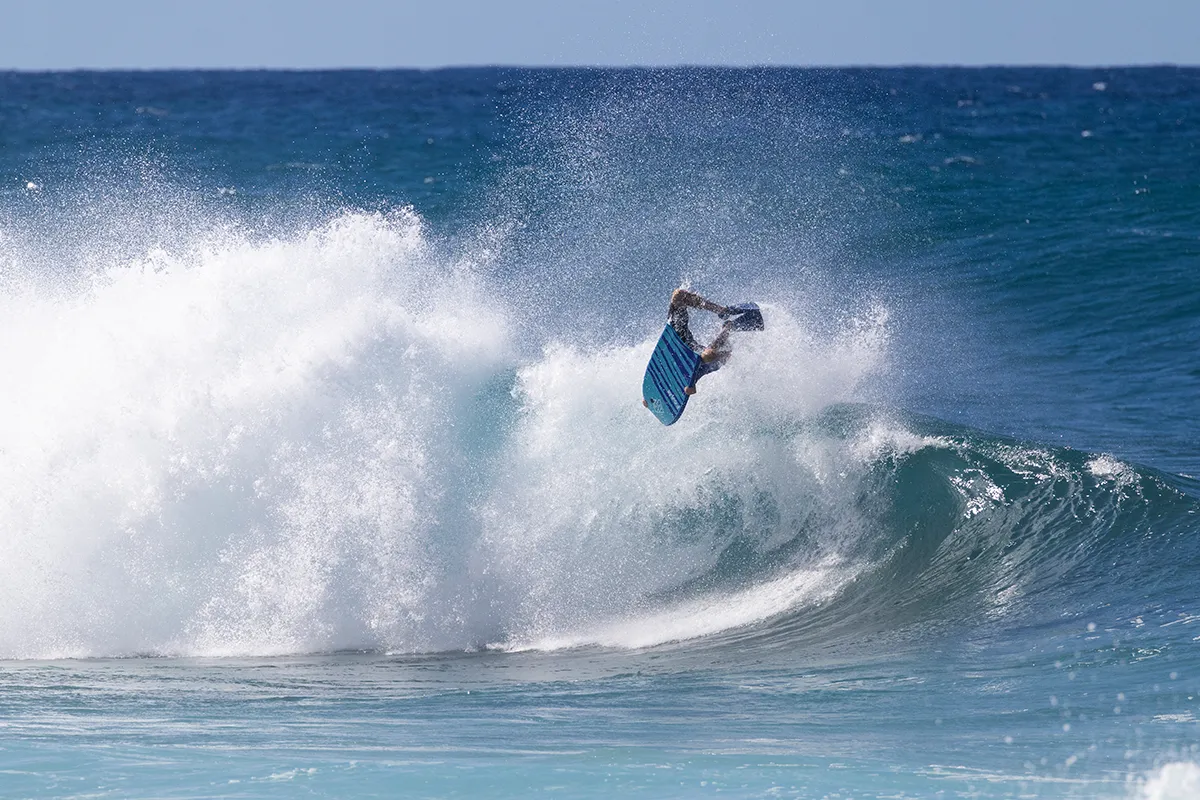
Even now, despite the chaos of running our own businesses, we still find time to trade playful jabs on WhatsApp. Rob fires over shots of big prone airs from an unnamed Cornish wedge or deep in the tropics of Sumatra, while I reply with dropknee snaps from my local spot in Portugal. It’s basically two ageing boogers shadowboxing from opposite corners of the world, each trying to bruise the other’s ego while secretly admiring the craft.
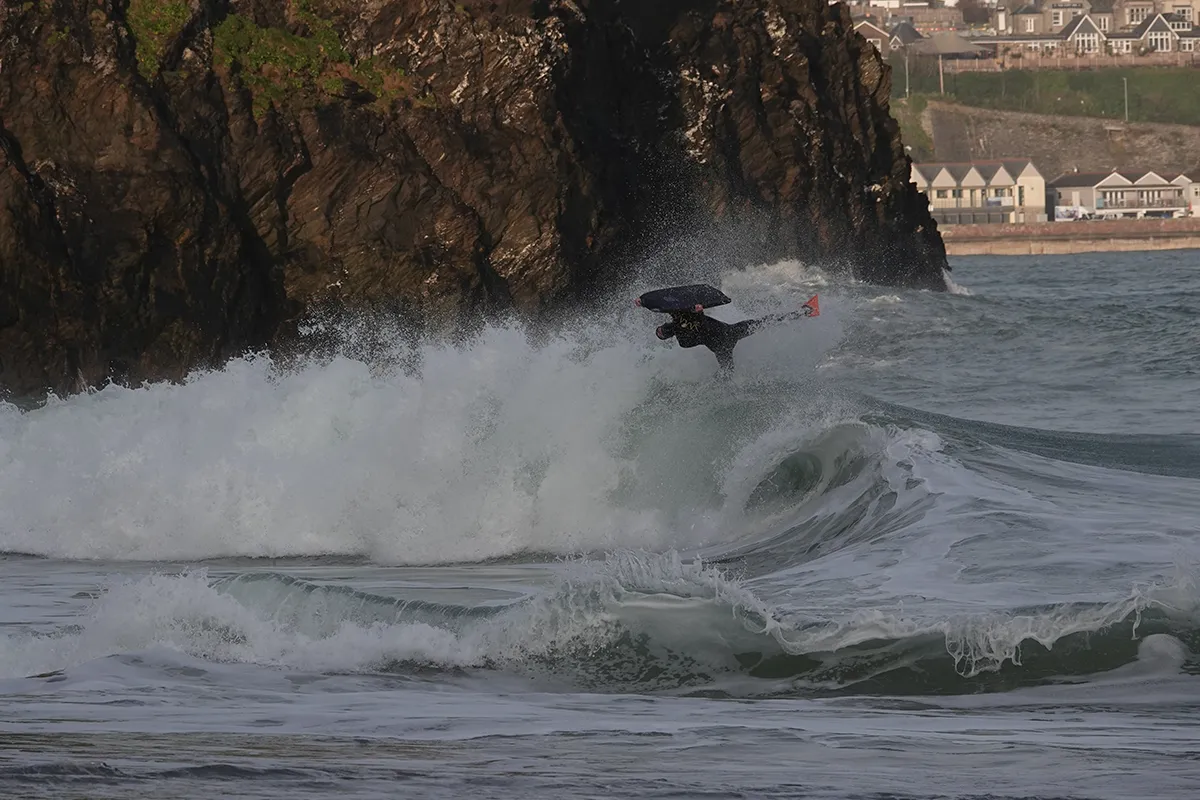
Rob taking to the skies, shortly before WhatsApping this to me. Credit: Andrew Course
So when we linked up during the annual Bodyboard Holidays trip in El Salvador, it only felt right to finally settle the debate properly: which is better, prone or dropknee?
Touch Gloves: The Opening Round
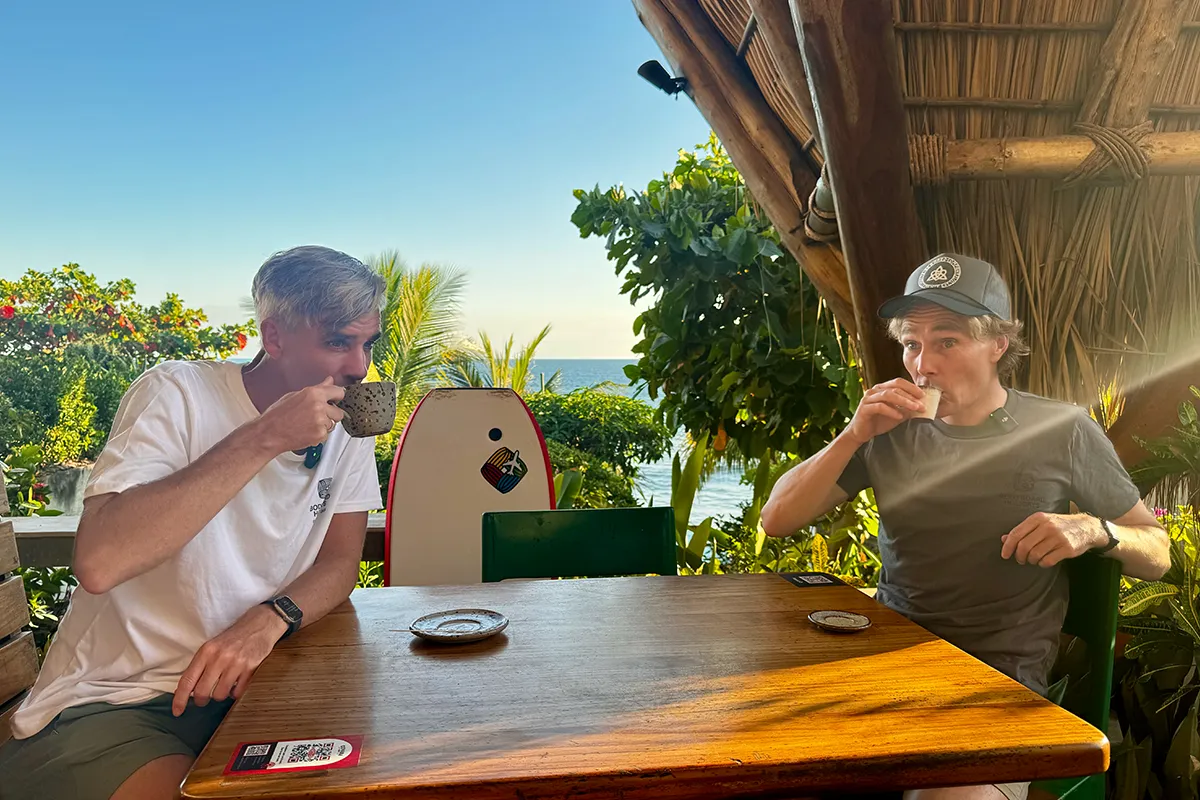
The setting couldn’t have been more perfect. Sitting in our favourite sunset restaurant overlooking the point, it felt less like a casual conversation and more like a UFC pre-fight press conference. You could almost hear Bruce Buffer introducing us.
Rob came out swinging immediately.
His opening argument was clean and direct: historically speaking, the bodyboard was invented by Tom Morey to be ridden prone. A strong first punch.
“Invented by Tom Morey, pioneered initially in the prone position and historically coming from the Paipo board …history is on my side” Rob Barber
But I kept my composure and fired back quickly.
From the very beginning of bodyboarding, dropknee had always existed alongside prone. Pioneers like Jack Lindholm were already pushing it on the knee, so arguably both disciplines have been part of bodyboarding since its inception.
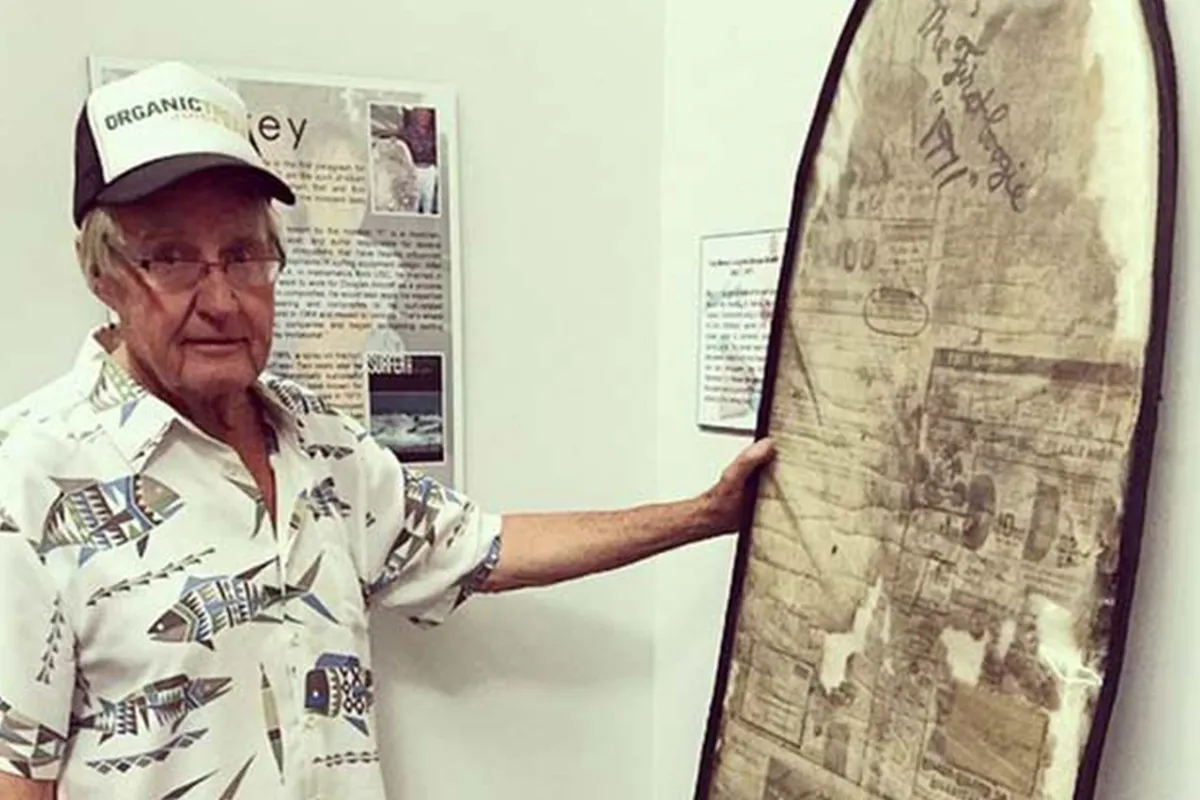
Tom Morey with the first bodyboard prototype. Credit Vert Magazine.
The Prone vs Dropknee Debate Begins
Not wanting to lose momentum, I followed up with a quick jab. That back in the ‘80s and ‘90s, being a complete bodyboarder meant being able to do both. Riders weren’t boxed into one lane. Versatility mattered.
Rob, now slightly backed onto the ropes, asked me to name five riders who could genuinely do both at a high level.
It felt like bait, but I bit immediately, naming Damian King, Mason Rose, Ben Holland, Jay Reale and Dave Hubbard, to name but a few. – All riders who inspired me growing up because they blurred the line between the two styles so effortlessly.
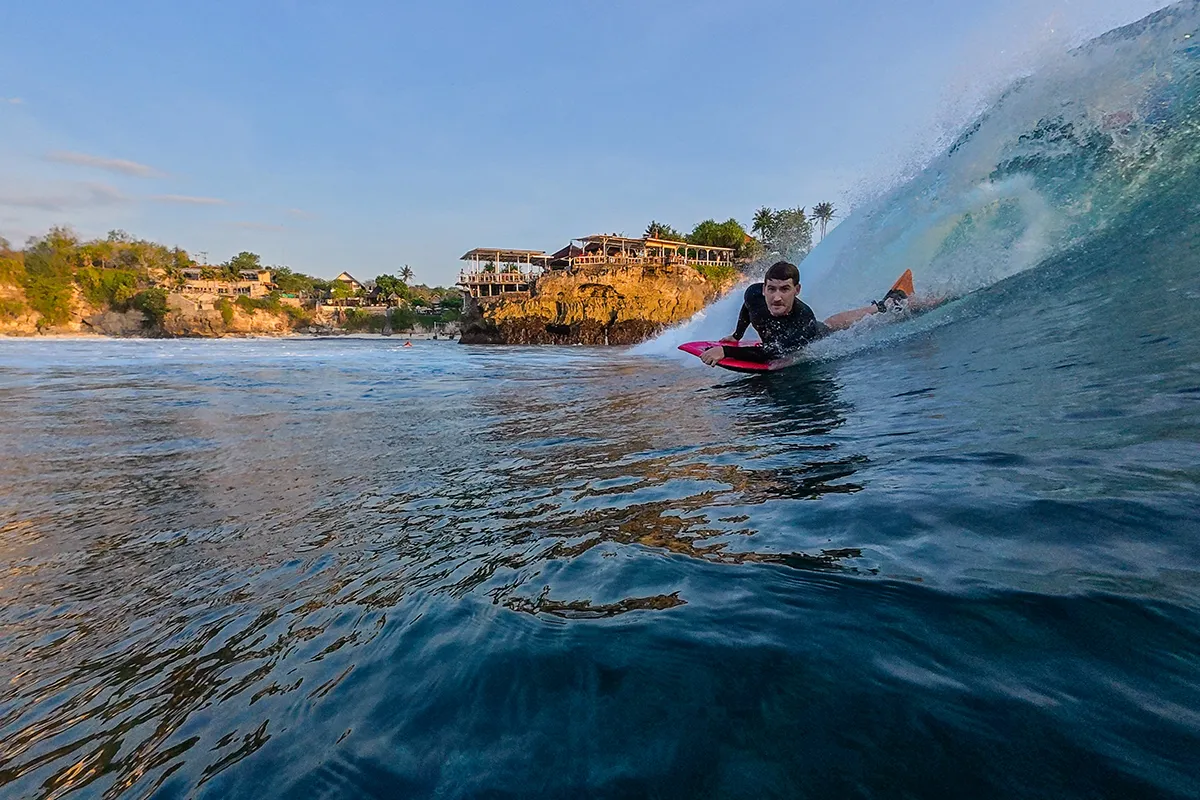
Bodyboard Holidays coach and former World Champion Iain Campbell on our recent Nusa Lembongan trip
Rob Lands a Heavy Shot
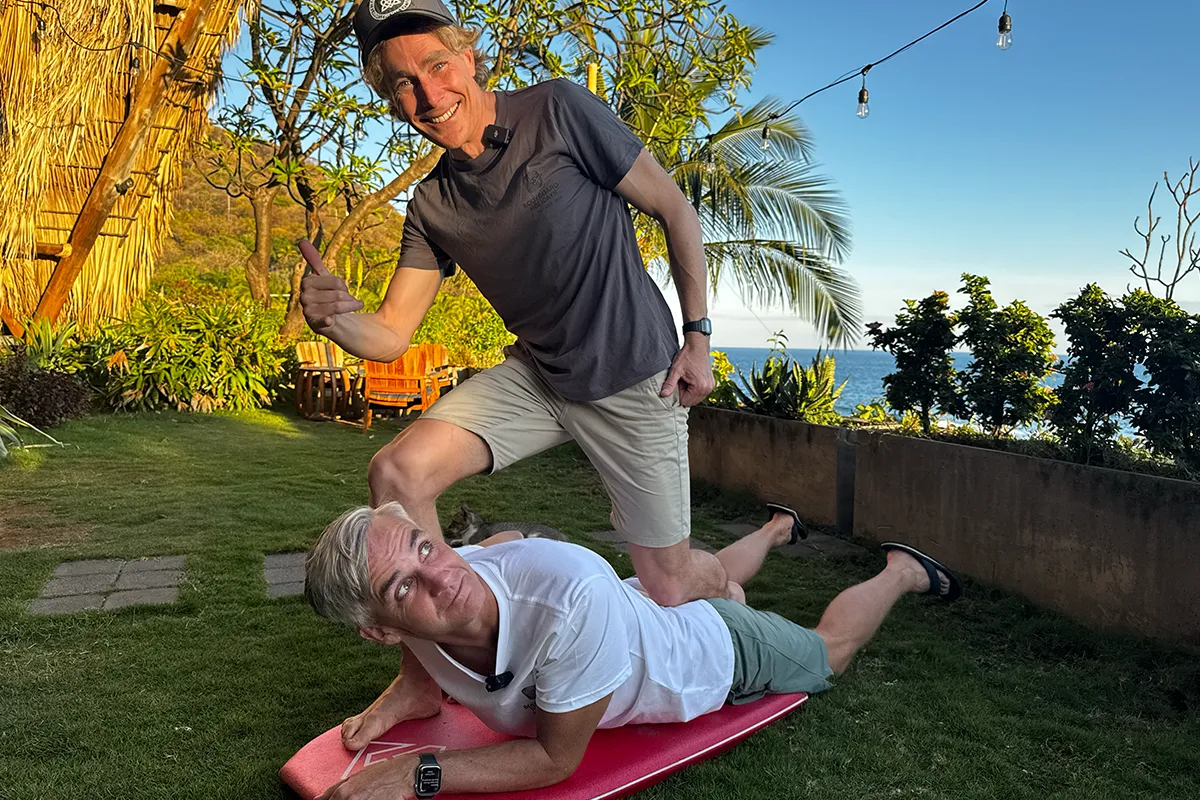
Mave arguing hard for Drop Knee supremacy!
Not wanting to lose the round, Rob answered with a proper heavyweight counter.
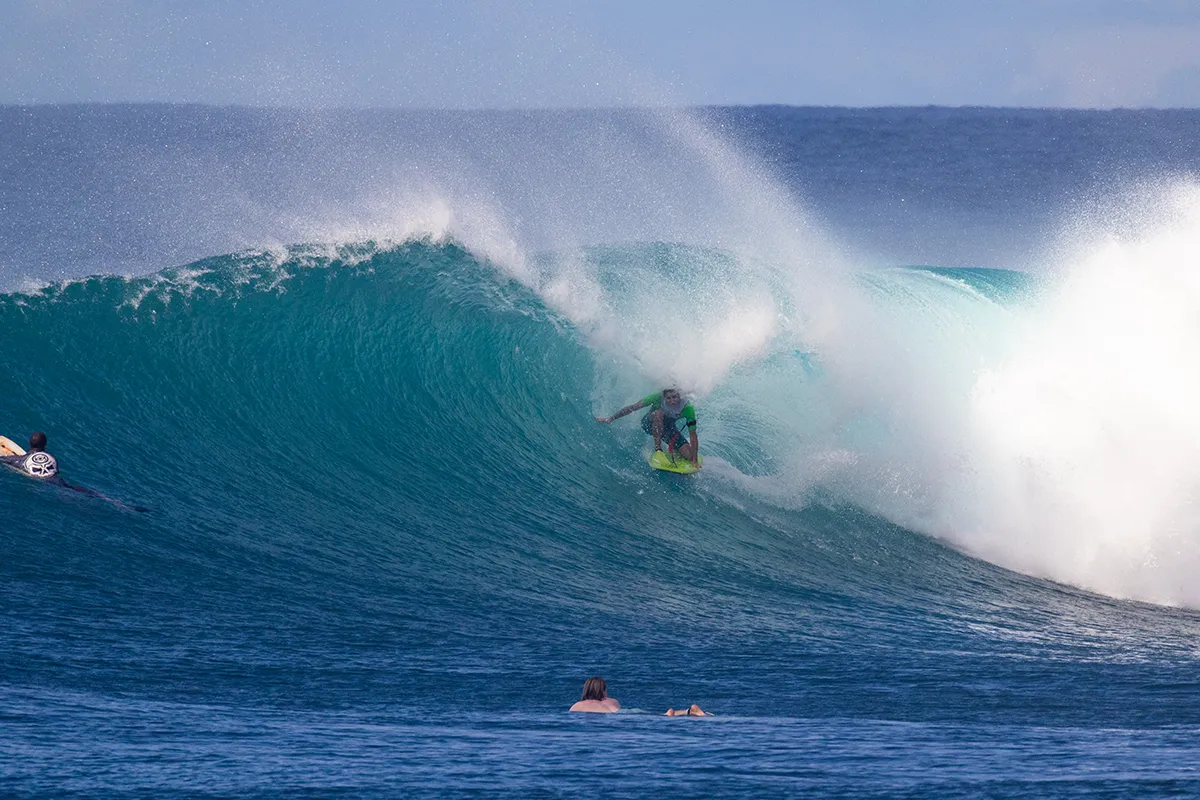
“The pinnacle of bodyboarding,” he argued, “is big airs and deep barrels in heavy slabs.”
And to be fair, it was a strong point.
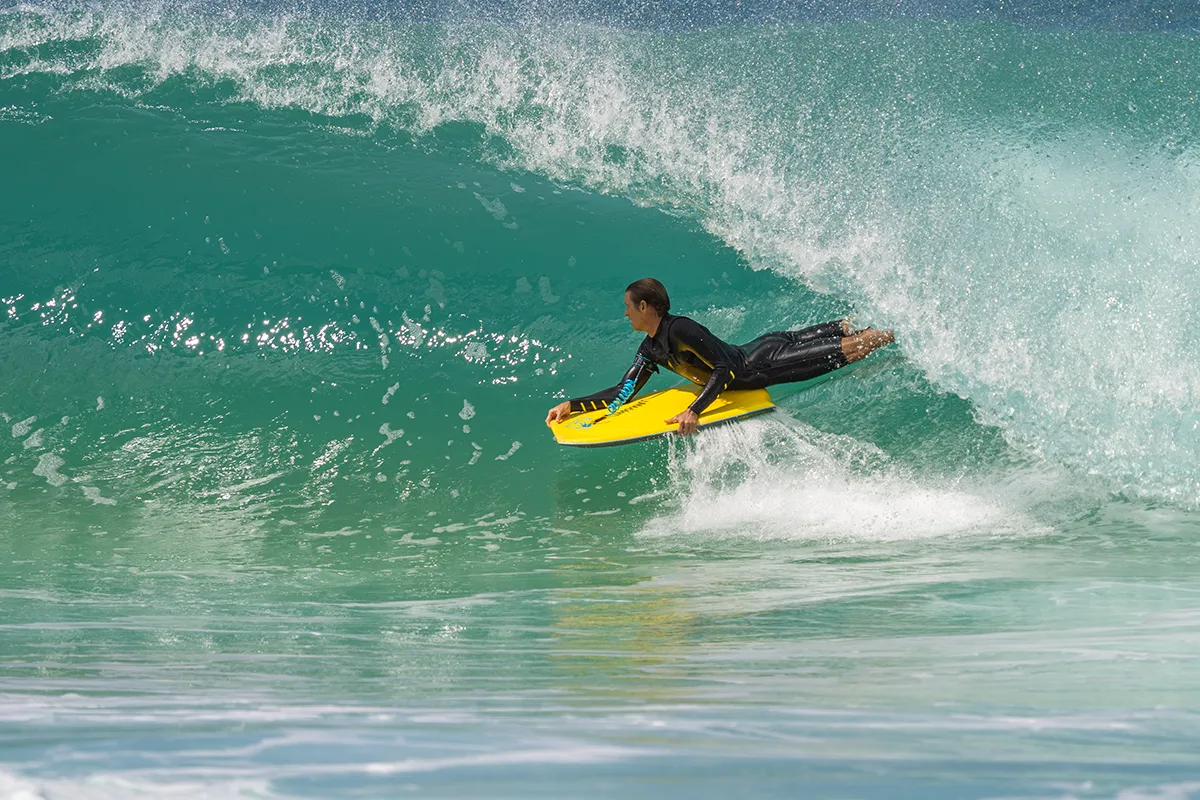
There’s something undeniably visceral about riding prone in heavy water. Watching someone scoop into a thick slab, set a rail, and thread a heaving cavern at full speed is part of what makes bodyboarding so unique. And when the section opens up, the ability to launch massive airs from critical sections adds another layer entirely, equal parts control, creativity, and chaos. Few disciplines match that level of commitment and raw performance when the surf gets serious.
“This is where bodyboarding comes into its own, it’s the ultimate tube riding vehicle, and bodyboarding at its most extreme is a gymnastic sport doing backflips, air reverses and spins in the barrel” Rob Barber
But in the pressure of the occasion, Rob fumbled his words when trying to pronounce Tahiti’s famous slab, Teahupo’o, and I sensed weakness like a fighter seeing a guard drop.
So I pressed forward.
Jeff Hubbard on the ultimate tube riding vehicle
Why Dropknee Offers More Versatility
Ironically, many advanced bodyboarders I know eventually drift toward stand-up surfing because they no longer have the time to chase bodyboarding specific waves suited for big airs and heaving tubes. Advanced prone riding demands steep, hollow, high-performance conditions to truly come alive.
Dropknee, on the other hand, offers versatility.
“Dropknee you can do most of the same moves that you can do on a surf board but if you have a wave that warrants going prone you can jump down on your belly” Matt ‘Mave’ Davies
You can ride waves of consequence dropknee, but you can also have fun when conditions aren’t perfect. Average surf can still feel creative and expressive. That accessibility keeps people engaged longer.
That versatility landed cleanly.
The bell rang shortly after, and as we returned to our corners, I felt like I’d edged the first round with that late uppercut.
“The beauty of dropknee is it’s more versatile and get away with doing it in less consequential waves but still having fun” Matt ‘Mave’ Davies
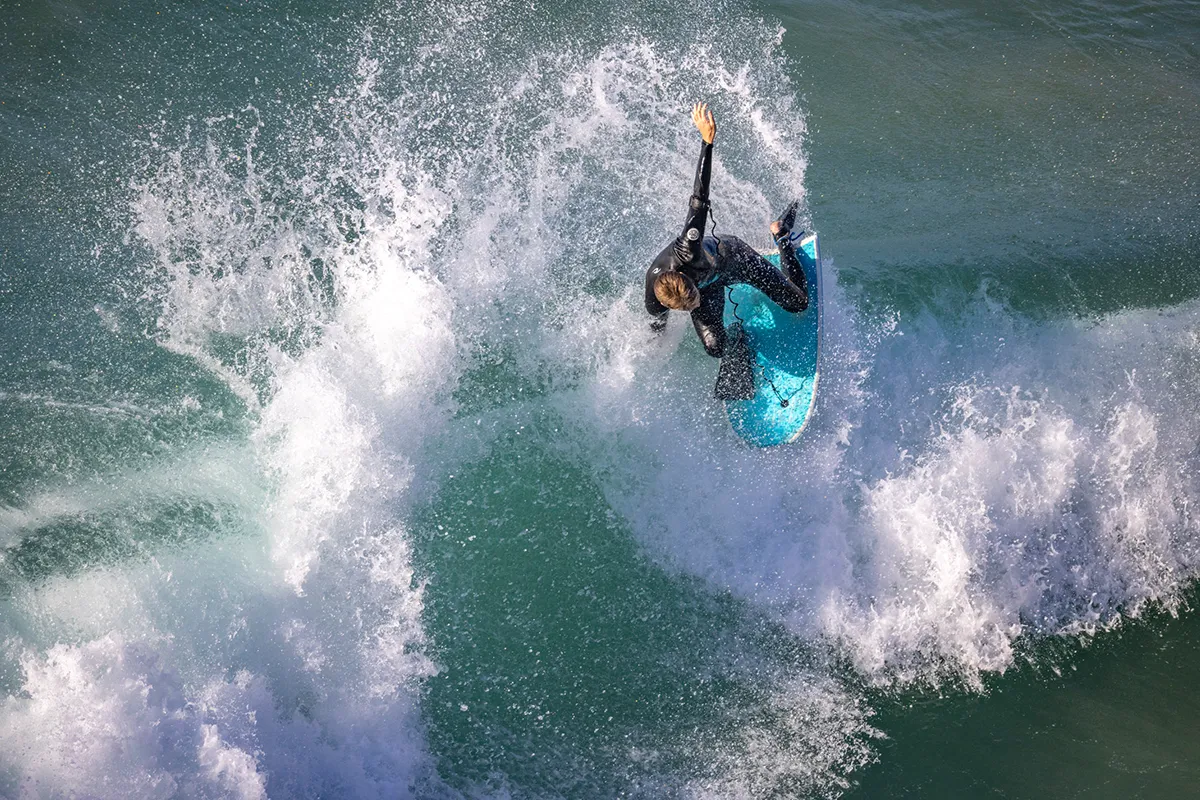
Matt ‘Mave’ Davies showing dropknee’s versatility and style during our Portugal bodyboarding holiday
Round Two Gets Messy – The Problem Facing Modern Dropknee Riding
Rob came out for round two exactly like he had in the first: aggressive and looking for damage.
This time he landed hard.
His argument was brutally honest: while good dropknee looks incredible, average dropknee can look… pretty awful.
“Seeing Dave Hubbard ride is a pleasure …but then there is a subterranean level (of dropknee rider) who are a bit jerky, that don’t look smooth and are painful on the eye …very rarely does it inspire” Rob Barber
And the dangerous thing? I actually agreed with him.
You could almost see my coaching staff panicking from the sidelines. Why was I agreeing with my opponent mid-fight?
But sometimes the best counters come from absorbing the shot first.
The real issue, I argued, is that there simply aren’t enough dropknee competitions anymore. Without events, there’s less exposure. Without exposure, fewer people dedicate themselves to mastering it. The standard naturally stagnates.
If more competitions existed, more riders would invest time into learning properly. The level would rise again. We’d start seeing another golden era where riders like Kainoa McGee, Paul Roach, Matt Lackey and Raffi Meyer featured heavily in magazines and films, inspiring the next generation.
Still, when the bell rang to end the second round, it was clear Rob had taken it. Clean punches. Better control. We were level going into the final round.
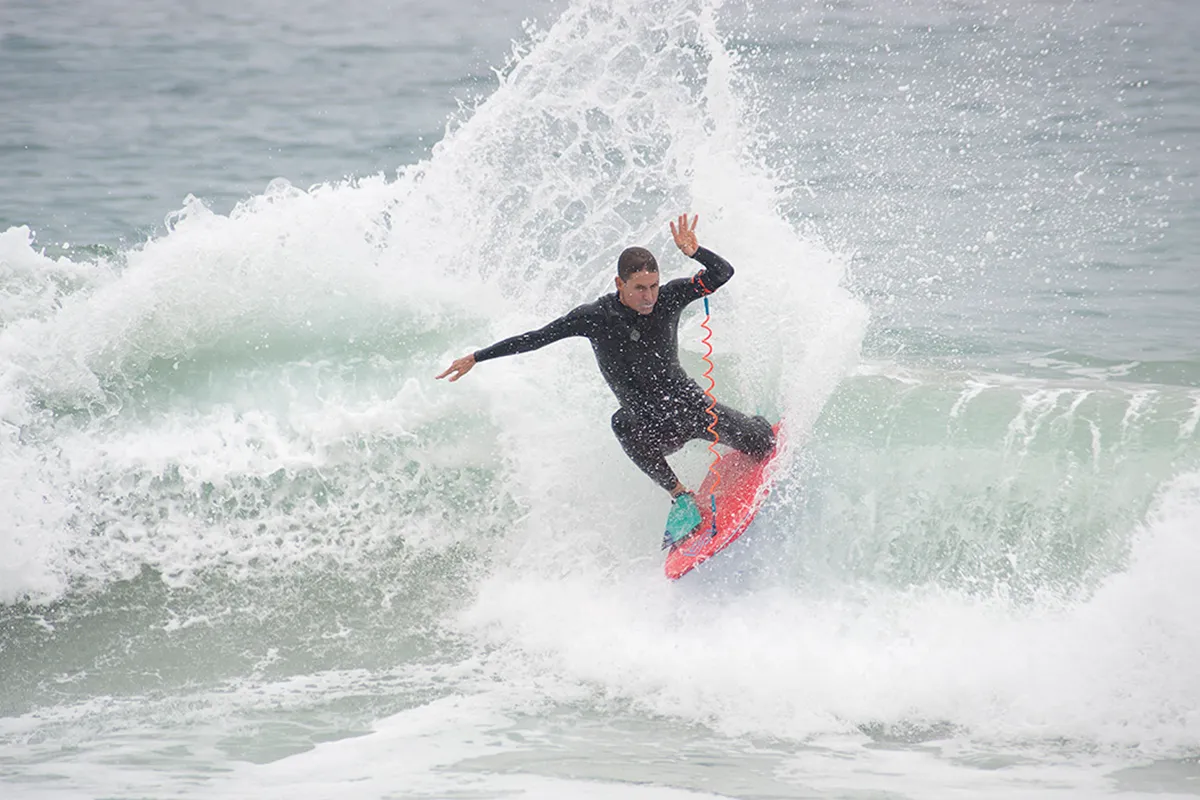
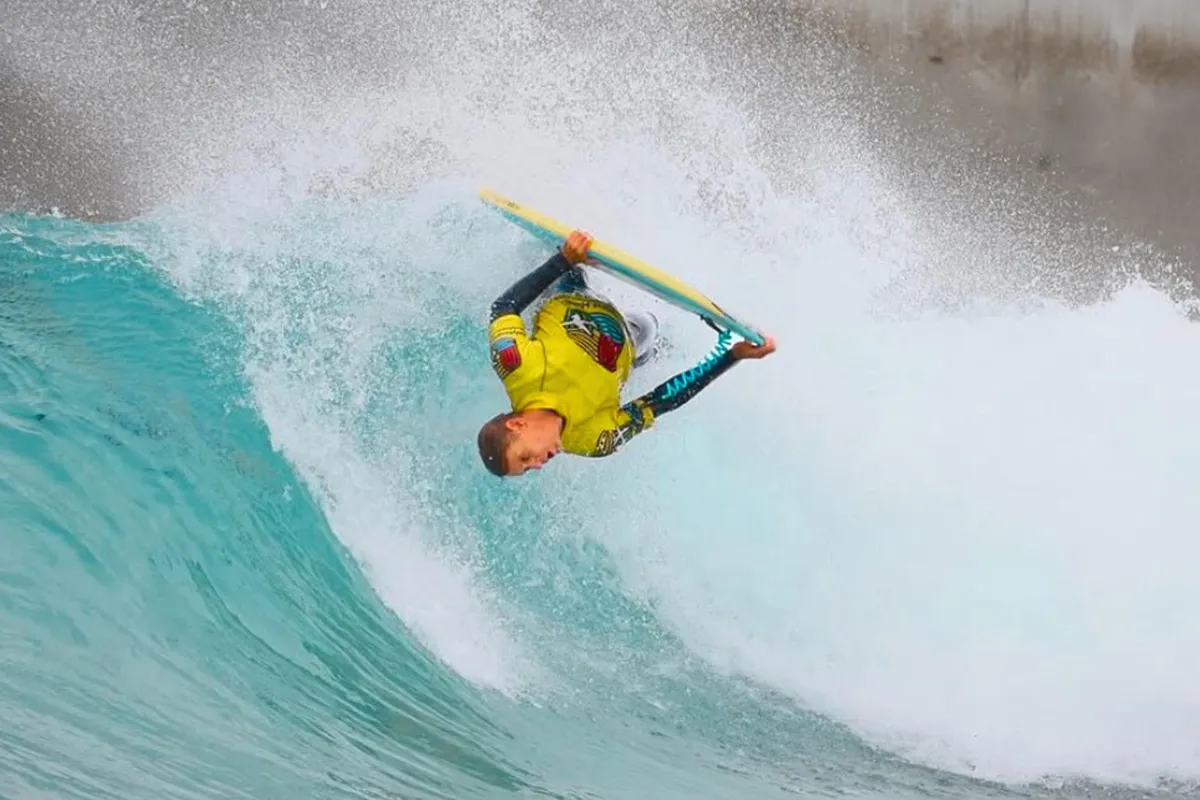
Dave Hubbard going backside
The Final Round – What Makes a Complete Bodyboarder?
By the third round, both of us had slowed slightly.
Maybe it was fatigue. Maybe too much El Salvadorian coffee. Maybe the weight of trying to solve an argument bodyboarders have been having for decades.
But something interesting happened.
The harder we debated, the more obvious it became that neither discipline actually diminishes the other.
“The win here, is that a bodyboard is a versatile wave riding vehicle” Matt ‘Mave’ Davies
Prone and dropknee both bring something completely different to bodyboarding. One offers explosive tube riding and progression in critical waves. The other delivers flow, style and versatility across a broader range of conditions.
And truthfully? Most of us enjoy both.
That’s probably the real victory here.
Dave Hubbard proving he can go just as big prone as he does dropknee
Why Both Styles Matter to Bodyboarding
Bodyboarding’s strength has always been its adaptability. Few wave-riding crafts allow so many different approaches within the same culture. Whether you’re pulling into a slab prone or cranking a long drawn out cutback dropknee, you’re still speaking the same language. – Not to mention riding stoogie (stand up on the bodyboard).
As the final bell rang, neither Rob nor I truly claimed the belt.
And maybe that’s exactly how it should be.
Watch the Full Debate on Drop Knee Vs Prone bodyboarding – Rob Barber Vs Matt ‘Mave’ Davies
If you want to decide for yourself who won the big debate, watch the full video interview between Rob and I.
And if you’re looking to improve your own prone or dropknee riding, consider joining one of the Bodyboard Holidays Central America trips. Over the years we’ve seen boogers dramatically improve their level through video analysis, in-water tuition and the luxury of warm water sessions day after day.
Whether you’re chasing deeper barrels, drawing cleaner lines, or simply trying to add another weapon to your game, there’s no better bodyboard coaching camp than consistent waves, experienced trainers and a few rounds with people who love bodyboarding as much as you do.
Alternatively, if you want to see first hand, and judge for yourself what is better prone or dropknee, be sure to join us on our Lost Shore Coaching Day with Jeff & Dave this July, where 3 x World Bodyboarding Champion and aerial master, Jeff Hubboard will be pitting his prone wits in the pool against his brother Dave Hubboard, 10 x Dropknee World Champion.
Matt, Mave to his friends, has been bodyboarding since he was 15 years old – now with over 30 years of bodyboarding under his belt it’s shaped his life in amazing ways and taken him all over the world. Mave has been living in Portugal for 15 years now, drawn to the impeccable waves, the climate and the culture. He speaks fluent Portuguese and knows all the secret spots to share with the bodyboard holiday trippers! Mave has been working with Bodyboard Holidays for 10-15 years and is a highlight of the trip for guests and staff alike, he loves to meet great people and make new friends to share his passion for bodyboarding with.
To provide the best experiences, we use technologies like cookies to store and/or access device information. Consenting to these technologies will allow us to process data such as browsing behavior or unique IDs on this site. Not consenting or withdrawing consent, may adversely affect certain features and functions.
Functional
Always active
The technical storage or access is strictly necessary for the legitimate purpose of enabling the use of a specific service explicitly requested by the subscriber or user, or for the sole purpose of carrying out the transmission of a communication over an electronic communications network.
Preferences
The technical storage or access is necessary for the legitimate purpose of storing preferences that are not requested by the subscriber or user.
Statistics
The technical storage or access that is used exclusively for statistical purposes.The technical storage or access that is used exclusively for anonymous statistical purposes. Without a subpoena, voluntary compliance on the part of your Internet Service Provider, or additional records from a third party, information stored or retrieved for this purpose alone cannot usually be used to identify you.
Marketing
The technical storage or access is required to create user profiles to send advertising, or to track the user on a website or across several websites for similar marketing purposes.
To provide the best experiences, we use technologies like cookies to store and/or access device information. Consenting to these technologies will allow us to process data such as browsing behavior or unique IDs on this site. Not consenting or withdrawing consent, may adversely affect certain features and functions.
Functional
Always active
The technical storage or access is strictly necessary for the legitimate purpose of enabling the use of a specific service explicitly requested by the subscriber or user, or for the sole purpose of carrying out the transmission of a communication over an electronic communications network.
Preferences
The technical storage or access is necessary for the legitimate purpose of storing preferences that are not requested by the subscriber or user.
Statistics
The technical storage or access that is used exclusively for statistical purposes.The technical storage or access that is used exclusively for anonymous statistical purposes. Without a subpoena, voluntary compliance on the part of your Internet Service Provider, or additional records from a third party, information stored or retrieved for this purpose alone cannot usually be used to identify you.
Marketing
The technical storage or access is required to create user profiles to send advertising, or to track the user on a website or across several websites for similar marketing purposes.